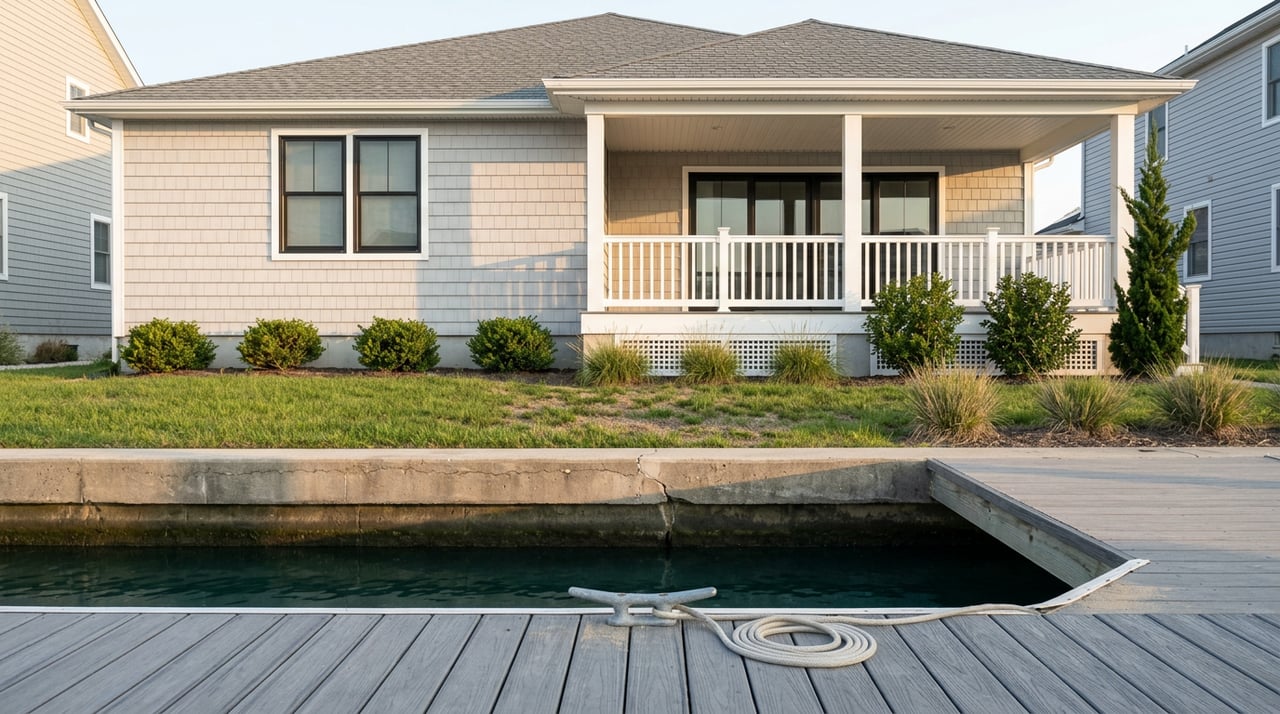
Every listing for a canal-front home in Hidden Harbor near Bishopville leads with the same line: no HOA. For buyers used to a few hundred dollars a month in dues at other Maryland and Delaware beach communities, that phrase reads like found money. No board meetings, no special assessments, no monthly bill for a pool you never use.
That reading misses what the phrase is actually doing. In a canal neighborhood, an HOA isn't just a rulebook. It's a pooling mechanism, a way of spreading the cost of the water itself, the bulkhead along it, and the dock that sits on it, across every owner instead of leaving each one exposed on their own. Take that mechanism away and the cost doesn't disappear. It moves. It lands on whoever happens to own the house when the bulkhead finally needs replacing, and it lands on them alone.
What an HOA Would Normally Be Doing
In a managed canal community, dues typically fund things a single owner would struggle to justify paying for alone: periodic dredging so boats can still reach open water, a reserve account for bulkhead or seawall work, and often a blanket permit history the association can point to when a shoreline project comes up. Neighboring Lighthouse Sound, just down the road in Bishopville, runs on that model. Dues there fund shared upkeep the same way they fund the golf course and the restaurant on site.
Hidden Harbor has none of that pooling. There's no association reserve fund, no shared dredging schedule, no blanket permit precedent. Every bulkhead, every dock, every foot of shoreline belongs entirely to the individual owner who happens to hold the deed. The upside is real, and it's the reason people buy here anyway: homes sit on canals that connect through Grey's Creek to Assawoman Bay, close enough that Ocean City is roughly a ten-minute boat ride away, and the neighborhood borders the 574-acre Grey's Creek Nature Preserve, with walking trails most HOA-fee communities would charge extra to build. You're trading a monthly bill for a lump sum you don't get to schedule yourself.
Where the Money Actually Moves
Laid side by side, the difference between a managed canal community and a no-HOA one like Hidden Harbor looks like this:
| Expense | Typical HOA-managed canal neighborhood | Hidden Harbor (no HOA) |
|---|---|---|
| Canal dredging | Bundled into dues, scheduled by the association | Arranged and paid for by the individual owner, on their own timeline |
| Bulkhead or seawall repair | Often subject to association standards, sometimes shared cost pools | Full responsibility of the current owner, no reserve fund to draw on |
| Shoreline construction permits | Association may have prior approvals or precedent to point to | Each owner applies individually through the county |
| Dock and boat lift insurance | Frequently bundled into the association's policy | Owner insures their own dock and hardware separately |
| Common roads and landscaping | Covered by monthly dues | Not applicable, since there's no shared infrastructure to maintain |
None of this makes Hidden Harbor a worse buy. It makes it a different kind of buy, one where the price you see on a listing is standing in for information an HOA reserve statement would normally give you for free.
Why the Price Spread Here Is So Wide
That standing-in effect shows up directly in the numbers. As of August 31, 2026, active listings across Bishopville's waterfront footprint showed a median list price of $999,999 across 19 properties, averaging $354 per square foot with homes sitting on the market an average of 117 days. That's a wide spread for a small, unincorporated waterfront pocket, and the no-HOA structure is a big part of why.
At one end of that range sit older canal homes and manufactured waterfront properties, the kind where a previous owner deferred bulkhead work because there was no association pressing them to fix it. At the other end sits new construction like the coastal residence completed in 2024 by Euro Homes in nearby Bay View Estates, a 3,200-plus square foot home built with water on two sides and close to 360-degree bay views, shoreline work already current because it was part of new construction rather than something inherited. In a managed community, an HOA reserve fund smooths that gap. Here, the price is doing that job instead, quietly telling you how much deferred shoreline maintenance you're about to take on.
The Bulkhead Question That Surfaces at Inspection
This is where the savings from skipping HOA dues either holds up or evaporates. A standard home inspection checks the furnace, the roof, the electrical panel. It generally does not include a marine-specific evaluation of a bulkhead or dock, which means a Hidden Harbor buyer needs to ask for one separately rather than assume it's covered.
It also means any future repair runs through the county rather than an association board. Any construction channelward of the mean high water line in Worcester County's tidal waters requires approval and a permit from the county's Department of Environmental Programs before work can start. No HOA removes the association layer of oversight. It does not remove the county's.
Septic is worth the same scrutiny. Properties within roughly 1,000 feet of mean high tide fall inside the Chesapeake and Maryland Coastal Bays Critical Area, and a failing conventional system there may need to be upgraded to a Best Available Technology unit under Worcester County's septic upgrade program. That's not a cost an HOA would have covered anywhere in this area, but it's one more example of the same pattern: nobody is tracking this for you but you.
A few questions worth asking before writing an offer on a no-HOA canal property here:
- How old is the bulkhead or riprap, and has any of it visibly settled or shifted?
- Was the current dock or boat lift installed under a permit, and is a copy available?
- Has the home ever needed emergency shoreline repair, and how was it paid for?
- What type of septic system is on the property, and does it fall inside the Critical Area boundary?
- What is typical canal depth at low tide, relative to your own boat's draft, since no association is coordinating dredging on a schedule?
What You're Actually Paying For
None of this is an argument against Hidden Harbor. It's an argument for pricing it correctly. If you've already looked at Lighthouse Sound next door and wondered why the dues are so different from a no-HOA canal listing a few minutes away, the honest answer isn't about which neighborhood is nicer. It's about who is holding the risk on the water. Lighthouse Sound bundles that risk into a monthly bill and a golf course. Hidden Harbor hands it to you directly, in exchange for a lower carrying cost most months and land that backs onto a nature preserve most buyers only get by paying HOA dues for a comparable amenity somewhere else.
That trade works well for buyers who go in with eyes open, budget for the bulkhead the way they'd budget for a roof, and treat the county permit process as a normal part of ownership rather than a surprise. It works less well for anyone who read "no HOA" as a discount instead of a description of who's in charge.
A Few Questions Worth Asking Before You Look Further
Does "no HOA" mean I can build or dock without any approval at all? No. Even without an association, any construction channelward of the mean high water line in Worcester County's tidal waters needs a permit from the county's Department of Environmental Programs. The HOA layer is gone. The county layer isn't.
Is a special septic system required in this area? If the property sits within roughly 1,000 feet of mean high tide, it falls inside the Critical Area, and a failing conventional system may need to be upgraded to a Best Available Technology unit under the county's grant program. New construction in this zone is often built with that requirement already in mind.
How would I even know if a canal is due for dredging? There's no association tracking it for you, so ask the seller directly, look for exposed mud or a noticeably shallower channel at low tide, and consider a marine survey before you close if boat access matters to how you plan to use the property.
If you're comparing Hidden Harbor to a managed canal community and want help reading a specific listing's shoreline and permit history before you make an offer, that's exactly the kind of due diligence a Resort & Second-Home Property Specialist license and dual Maryland and Delaware licensing are built for. Reach out to Timothy Dozier at TimSellsTheBeach to walk through what a particular Hidden Harbor property is actually asking you to take on before you write the offer.


